Safety and dosing

Plus tolerability and administration information.

Study design

The OCEANIC-STROKE study was a multicenter, randomized, placebo-controlled, double-blind, and event-driven phase 3 study designed to demonstrate the efficacy and safety of SUNHARBO® (50 mg once daily) in combination with antiplatelet therapy (APT) for the prevention of ischemic stroke in adults 18 years or older after an index event of acute non-cardioembolic ischemic stroke (NIH Stroke Scale ≤15) or high-risk transient ischemic attack (TIA) (ABCD2 score ≥6). Patients were randomized within 72 hours after onset of symptoms.1

ABCD2=Age, Blood Pressure, Clinical Features, Duration, and Diabetes.
Safety bleeding data

Clinical safety outcomes1

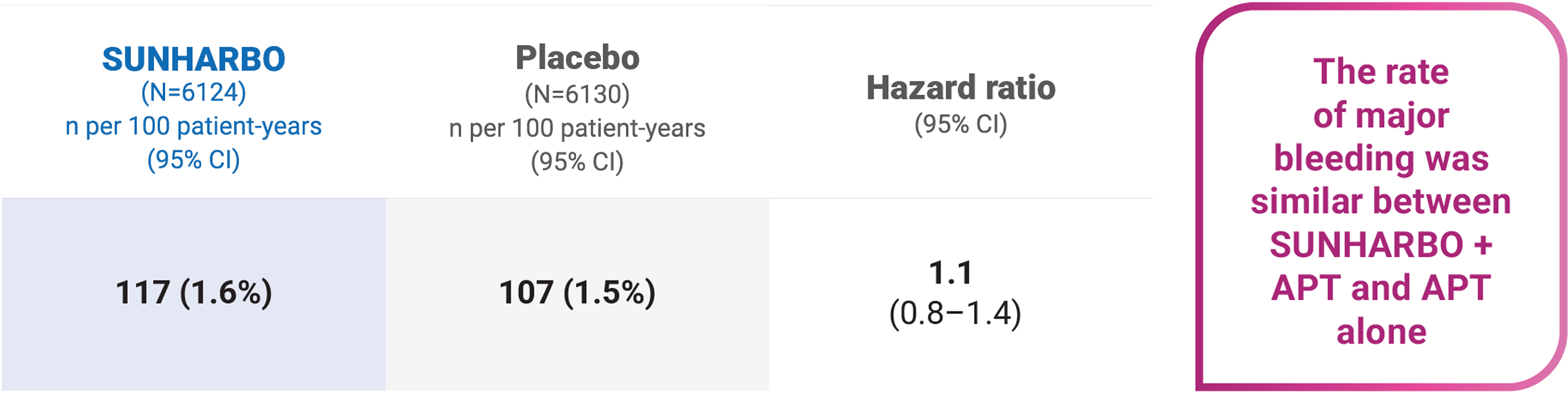
Primary safety endpoint: Time to first occurrence of major bleeding

primary endpoint
  • The rate of major bleeding events within 90 days of treatment initiation was 4.5 vs 3.1 per 100 patient-years in the SUNHARBO + APT and APT alone groups, respectively, (HR 1.46, 95% CI 0.99–2.16)
  • In patients planned to receive DAPT, the rate of major bleeding events was 1.9 vs 1.5 per 100 patient-years in the SUNHARBO + APT group and the APT alone groups, respectively. In subjects not planned to receive DAPT, rates were similar between groups (1.3 vs 1.4 per 100 patient-years)
  • Among patients older than 75 years old (25% of the study population), the rate of major bleeding was 2.6 vs 1.7 per 100 patient-years in the SUNHARBO + APT and APT alone groups, respectively
  • In the high-risk TIA subset (5% of the study population), the rate of major bleeding was 2.9 vs 1.0 per 100 patient-years in the SUNHARBO + APT and APT alone groups, respectively
    • The median onset of major bleeding events in the high-risk TIA subset in the SUNHARBO + APT group was 30 days

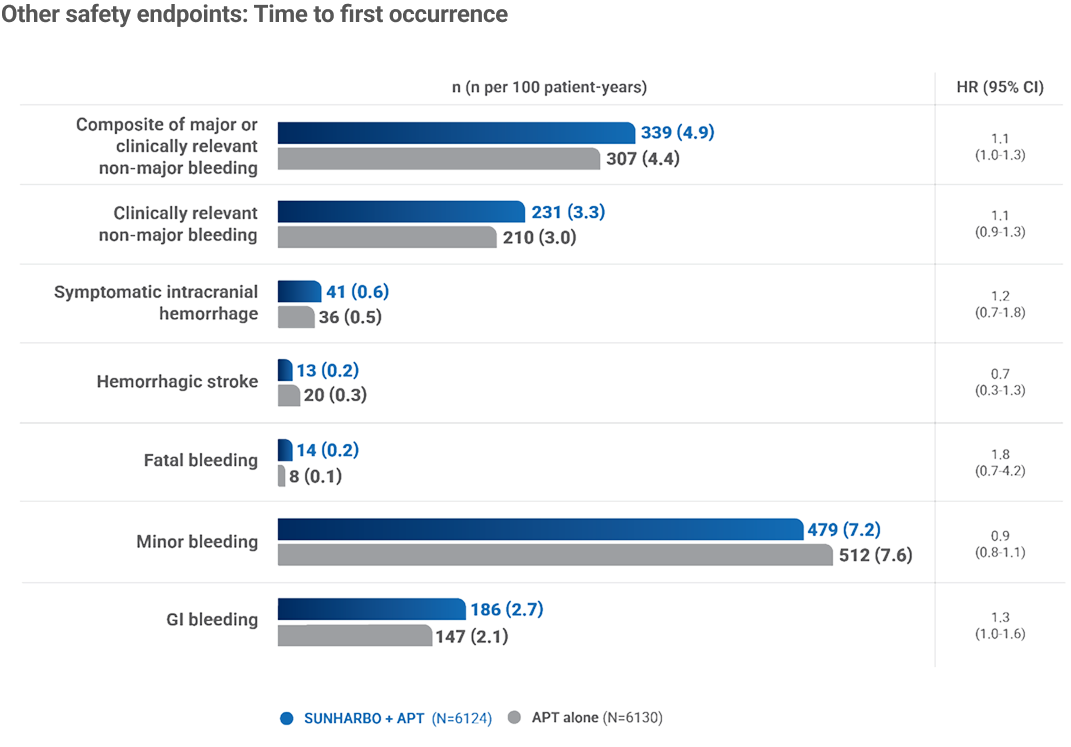
Other safety endpoints1

GI bleeding

  • The rate of GI bleeding was higher in the SUNHARBO + APT group compared to APT alone (2.7 vs 2.1 per 100 patient-years), (HR 1.3, 95%  CI 1.0–1.6)
  • The majority of GI bleeding events in the SUNHARBO + APT group (74%) were clinically relevant non-major or minor bleeding
  • The most frequent bleeding site was of rectal origin
Secondary endpoints 

Discontinuation rates

Similar discontinuation rates between treatment groups1

Similar discontinuation rates between treatment groups

10%

SUNHARBO

10%

placebo

The most common reason for treatment discontinuation in both groups was newly diagnosed atrial fibrillation (~5% in each group), for which permanent discontinuation of SUNHARBO was required by the clinical trial protocol.

Adverse reactions

Diarrhea

  • The most frequently reported (>3%) adverse reaction in SUNHARBO-treated patients was diarrhea (3.4% vs 2.8% in the SUNHARBO and placebo groups, respectively)
  • Most cases of diarrhea in SUNHARBO-treated patients were reported within the first 2 months of treatment, were mild in severity, and resolved while on SUNHARBO (77%)

Hepatic enzyme increased

  • SUNHARBO is associated with elevated hepatic enzymes. An elevation of alkaline phosphatase (ALP) more than 2 times above the upper limit of the normal range occurred in 2% of SUNHARBO-treated patients and 1.8% of APT alone patients
  • Elevation of serum transaminases more than 3 times above the upper limit of the normal range without a simultaneous elevation in total bilirubin was observed in 2.0% of SUNHARBO-treated patients and 1.6% of placebo-treated patients
  • The majority (74%) of the hepatic enzyme increased events in SUNHARBO-treated patients were reported as mild in severity
  • Substantial cholestatic liver injury (ALP >1000 U/L) or serious liver injury with jaundice were each reported in less than 0.02% of SUNHARBO-treated patients

Dosing

One pill, one dose, once daily1

icon1
1 strength: 50 mg tablet
icon1
Once daily
icon1
No routine monitoring of 
aPTT or other coagulation parameters

Administration

food-icon
In combination with APT
food-icon
With or without food
tablet-icon
Tablet may be crushed and mixed with water or soft food*
gastric-tube-icon
Can be administered via nasogastric or gastric tube
*See PI for full administration information.

Dosing considerations

Surgery and other invasive procedures
  • SUNHARBO should be interrupted at least 24 hours before elective surgery or invasive procedure. SUNHARBO should be restarted after the surgical or other procedures as soon as adequate hemostasis has been established
  • Thrombolysis (with or without thrombectomy): Concomitant use of SUNHARBO within 48 hours prior to thrombolysis has not been studied, and the risk of bleeding is unknown; SUNHARBO should be withheld for at least 24 hours after thrombolysis for acute ischemic stroke
Hepatic impairment
  • No dose adjustment is required for patients with mild hepatic impairment (Child-Pugh A)
  • Use of SUNHARBO in patients with moderate to severe hepatic impairment (Child-Pugh B and C) is not recommended

aPTT=activated partial thromboplastin time; CI=confidence interval; GI=gastrointestinal; HR=hazard ratio; ISTH=International Society on Thrombosis and Haemostasis classification. 

Reference

  • SUNHARBO (asundexian) [prescribing information]. Whippany, NJ: Bayer HealthCare Pharmaceuticals, Inc.; November 2026.